
Emergency Roof Repair Near Me: What Newport Beach Homeowners Should Do First
If water is coming through your ceiling in Newport Beach, the first 90 minutes matter more than which contractor you’ll eventually hire. Move a bucket under the leak, pull back furniture and electronics, and photograph everything before you touch anything else. Then call a licensed roofer, not a storm chaser. If you’d rather not handle the initial steps alone, call (833) 589-5180 and we’ll talk you through it.
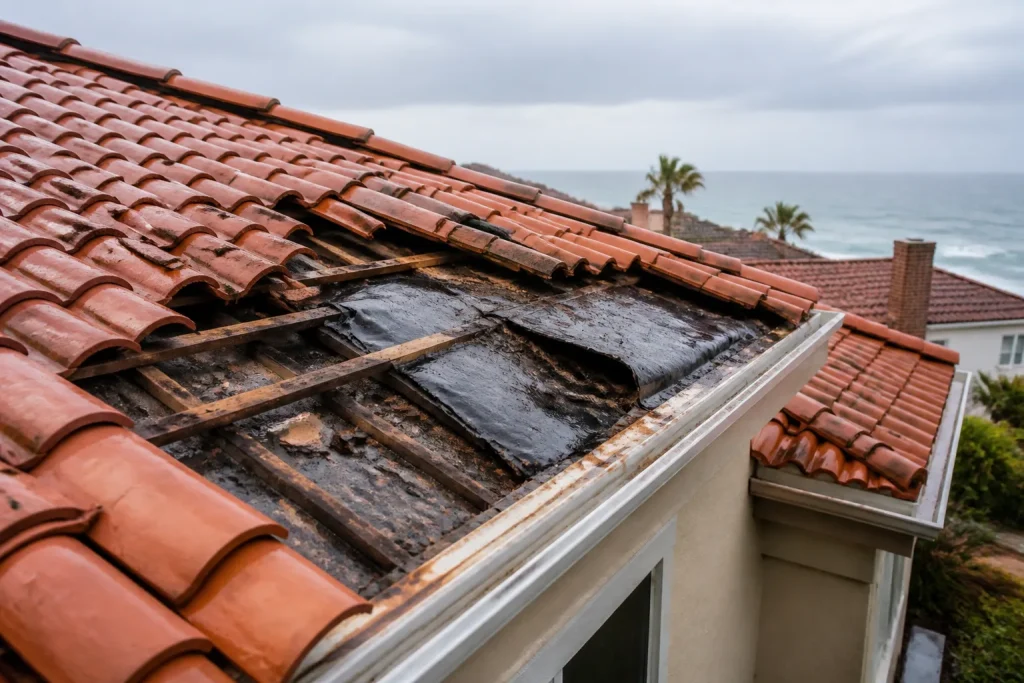
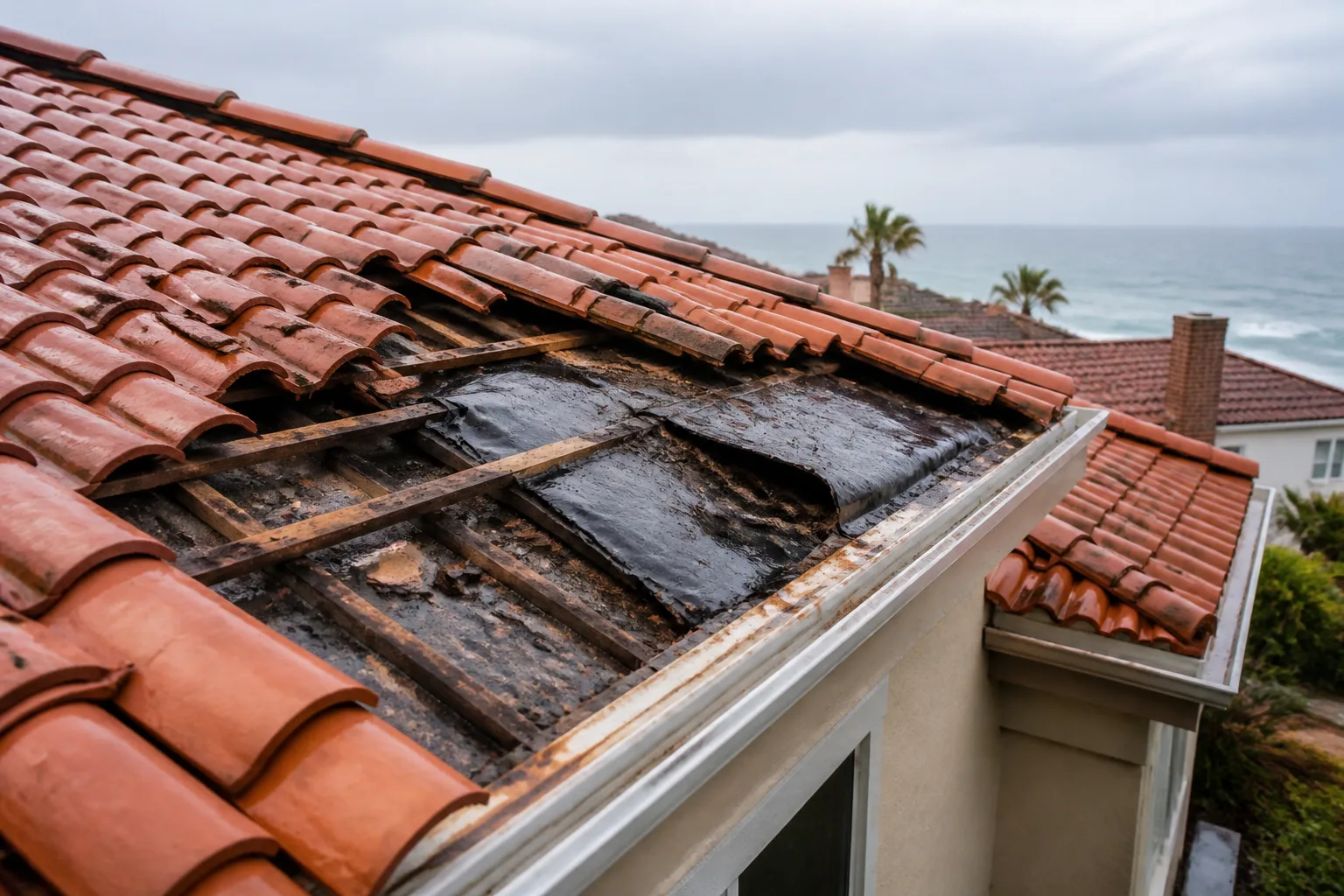
A Santa Ana wind event can lift flashing and put water in your walls before you’ve finished reading the first search result for “emergency roofer near me.” What you do in that first hour determines how much damage is recoverable, not which company shows up. We’ve watched homeowners in Corona del Mar spend 45 minutes comparing Yelp reviews while water wicked through their ceiling drywall and into the insulation above. By the time anyone arrived, the repair scope had doubled.
Stop the Interior Bleeding First: Your 90-Minute Priority Sequence
Before you call anyone, do three things in order. This sequence protects your home, your belongings, and your insurance claim.
- Contain the water. Position a bucket or trash can directly under the drip. If the ceiling is bulging, poke a small hole with a screwdriver at the lowest point of the bulge so water drains in one controlled spot instead of spreading through the drywall cavity. That might sound destructive, but it prevents the drywall from collapsing of its own weight and taking insulation, wiring, or a section of ceiling with it.
- Move what matters. Pull furniture, rugs, electronics, and anything upholstered away from the affected area. Water that sits in carpet pad or pooled on engineered hardwood starts causing secondary damage within hours. In Newport Beach humidity, mold follows quickly.
- Photograph before you clean. Take wide shots of the room, then close-ups of the ceiling stain, the drip source, and any visible water on walls or flooring. Insurers need to see the damage before you dry, scrub, or repair anything. Then, and only then, start mopping.
We inspect before we recommend. That goes for your emergency too. Document first, remediate second, and you’ll have a stronger claim when the adjuster calls.
Why Temporary Tarping Is Not a DIY Job
From the ground, tarping a damaged roof in Newport Beach looks like throwing a blue sheet over a ridge and nailing it down. It isn’t. A legitimate emergency tarp job involves anchoring the tarp over the affected slope, extending it past the ridge line, and sealing it so 40 mph Santa Ana gusts don’t turn your tarp into a sail. We’ve repaired roofs where a homeowner’s first attempt at a tarp lasted three hours before the wind ripped it loose and the leak came back worse.
A proper emergency tarp in this market typically runs between $400 and $900, depending on slope, roof height, and how much area needs coverage. At the low end, you’re getting a single small patch over one penetration point. At the high end, a two-story section with limited eave access and wind exposure in a hillside neighborhood like Spyglass Hill. If someone quotes you $150 for a full tarp job after a storm, ask how it’s anchored. The answer will tell you everything.
What to refuse: any contractor who wants to walk a steep roof in the dark without harness lines, anyone who won’t show you proof of insurance before stepping onto your ladder, and anyone who pressures you to sign a full replacement contract before you’ve even seen the scope of interior damage. Emergency work is about stabilization, not a sales close.
Documenting For Insurance: The Photos Adjusters Actually Need
Most Newport Beach homeowners photograph the ceiling stain and stop there. That’s the one photo adjusters care about least. What they need is evidence of the cause, the path, and the consequence.
- Exterior shots from the ground. Missing shingles, lifted flashing, displaced ridge cap, or visible impact points from wind-borne debris. Zoom in on the damaged section from at least two angles.
- The underside. If you have attic access, photograph the underside of the roof decking where the leak is active. The dark water staining tells the story of how long water has been intruding, and insurers use that to distinguish storm damage from pre-existing deterioration.
- Interior context. Wide room shots that show where the damage sits in relation to walls and windows, then close-ups of any ceiling cracks, wall staining, or pooling water.
- Every belonging that got wet. One photo per item, with a note of when you bought it and what you paid if you have it. A photo of a wet couch without a receipt is still better than no photo at all.
If someone from our team arrives before you’ve finished documenting, we’ll help you shoot what’s missing. That’s part of the stabilization work. We’re not there to replace your roof on the first visit. We’re there to stop the active intrusion and give you a straight assessment of what you’re looking at, whether that’s repair or replacement.
Questions to Ask Before Anyone Gets on Your Roof at 10 PM
Newport Beach gets its share of post-storm solicitors. Some are legitimate. Some are what the industry calls storm chasers: crews that follow weather events from state to state, working without local licenses, leaving warranties that evaporate the first time you call the number on the invoice.
Before you let anyone up a ladder, ask these five questions.
- Can I see your California contractor’s license? A roofer in Newport Beach needs a C-39 roofing classification under a current California license. Ask to see the physical card or look it up on the CSLB site while they wait. Legitimate roofers won’t flinch at this.
- Are you insured for this property, today? Liability and workers’ comp. If someone gets hurt on your roof and the contractor isn’t insured, that injury lands on your homeowner’s policy.
- What’s the specific scope of tonight’s work? The answer should be stop the water, tarp the vulnerable section, document the damage. It should not be a full replacement contract pushed across the kitchen table while the tape measure is still out.
- Where are you based? If the answer is a hotel near John Wayne Airport and the truck has out-of-state plates, treat that with caution. A roofer with a physical operation in Southern California is accountable after the storm moves on.
- Can you send me the estimate in writing before any work starts? A legitimate emergency stabilization should come with a line-item scope and a clear number. “We’ll figure it out later” is how $500 tarps become $5,000 change orders.
Sunridge does roofing only. No siding, no gutters, no windows. When we show up to an emergency in Newport Beach, every question gets answered from a roofer’s perspective, not a generalist trying to expand the job.
Why Newport Beach’s Weather Makes Preparation a Smart Investment
Newport Beach sits in a peculiar weather pocket. We don’t get the inland heat spikes of Irvine or the coastal saturation of Laguna Beach, but we do get Santa Ana wind events that regularly gust 40 to 60 mph through the fall, and we get winter storms that stall offshore and dump concentrated rain on coastal properties. What does that mean for roofs in Balboa Peninsula, Lido Isle, and the hills above Pacific Coast Highway?
Wind-driven rain finds entry points that calm rain doesn’t. A small lift in your flashing at the chimney, a loosened ridge cap, a slipped tile near a valley: none of these are problems in steady vertical rain. But when wind pushes water sideways at 45 mph, it sneaks under overlaps that haven’t leaked in fifteen years. That’s why so many Newport Beach “emergencies” happen during Santa Ana events with no cloud cover and then again three weeks later when the first real rain arrives.
Having a roofer’s contact saved before you need it changes the weather math. The homeowners we hear from who handled emergencies best weren’t the ones who found us fastest. They were the ones who had already had an inspection in a prior year, knew the name of the roofing material on their house, and had a rough idea of where the last maintenance item was flagged. Preparation isn’t about fear. It’s about not making a five-figure decision while water is actively flowing through your ceiling.
If you’re in Newport Beach and want a baseline inspection before the next Santa Ana season, our roof inspection is a standalone service. We don’t bundle it with a replacement quote and we won’t manufacture findings. Sometimes the report says your roof is in decent shape and we tell you to keep an eye on one flashing detail. That’s the report you want.
Related services in Newport Beach: Roof Inspection in Lynwood, Roof Repair in Lynwood, and Roof Replacement in Lynwood.
What We Pulled Off a Garage in Corona del Mar Last Winter
We got a call from a homeowner off Marguerite Avenue just after a January storm. Water was coming through the ceiling of a garage that had been converted into a home gym. The homeowner had already put a tarp on the roof himself, and it was flapping loose in 25 mph wind, slapping against the roof deck. He was proud of the tarp. We were looking at the water still dripping onto a treadmill.
The actual issue wasn’t where the ceiling was wet. It was three feet up the slope, where a corroded pipe boot around a plumbing vent had failed. Water was entering there, running along the roof deck, and dropping through the garage ceiling at the lowest point. The tarp covered neither the pipe boot nor the true entry point. We replaced the boot, patched the surrounding underlayment, and checked the deck for saturation. The repair was small. The lesson was bigger: water doesn’t drip straight down through a roof leak. It follows the rafter, the seam, the path of least resistance. What you see is rarely where the problem is.
That’s why we inspect before we recommend. Even in emergencies.
When to Call a Pro
If your roof is actively leaking, you need a professional assessment sooner rather than later. If you have vaulted ceilings with no attic access, don’t wait. If your home in Newport Beach is two stories with a steep pitch, don’t get on a ladder. If the leak is near electrical fixtures or running down a wall with outlets, cut power to that circuit at the breaker and call us from the driveway. Roof water and electricity are a bad combination.
You should also call a pro if you’re not sure whether the damage is storm-related or the result of gradual wear. That distinction matters for insurance claims. We’ll give you our honest read on what caused the problem and whether repair is the right move or replacement deserves a conversation.
The Bottom Line
Emergency roof repair in Newport Beach follows a simple order: contain the water inside, document the damage in photos, then get a licensed roofer on the phone. Don’t spend the first hour comparing search results. Don’t climb a wet roof or steep pitch. Don’t sign anything with a storm chaser who won’t show you a California contractor’s license.
When the immediate danger is handled, the longer-term decision comes down to repair versus replacement, and that starts with an honest inspection. We work with the brand that fits your roof and your budget, across product lines from Owens Corning, IKO, Atlas, Tamko, and other major manufacturers. Repair when repair is right, replace when it’s not.
If you’re in Newport Beach and dealing with an active leak or recent storm damage, call (833) 589-5180 for a free estimate. We’ll help you get the tarp on, the photos shot, and the next step clear.
Frequently Asked Questions
Put a bucket or container under the drip immediately, then move furniture, electronics, and anything water-sensitive out of the path. Take photos of the ceiling stain, the water path, and any exterior damage before you clean or dry anything. If the ceiling is bulging, poke a small drain hole at the lowest point to release pooled water in one controlled location. Then call a licensed roofer at (833) 589-5180.
A legitimate emergency tarp job in the Newport Beach area typically runs from $400 to $900, depending on roof slope, height, and how much area needs coverage. Be wary of $150 tarp quotes after a storm, because they usually mean an unlicensed crew with no insurance. Call (833) 589-5180 for an exact quote based on your roof.
Most homeowner’s policies in California cover sudden storm damage, which includes wind-lifted flashing or displaced shingles from a Santa Ana event. Gradual wear and tear is generally not covered. The photos you take in the first hour make the strongest case for coverage. Document before you clean.
If the repair means getting on a ladder or walking a wet roof, no. Newport Beach homes with steep pitches and two-story designs make that especially dangerous. Reinforce your containment from inside, keep the photos coming, and let a roofer handle the exterior. That’s what we’re here for.
Written by the team at Sunridge Roof Repair, serving Newport Beach since 2011.
Need Roofing Help?
Call Sunridge Roof Repair — licensed & insured, here with fast after-hours help in Lynwood.
(833) 589-5180