
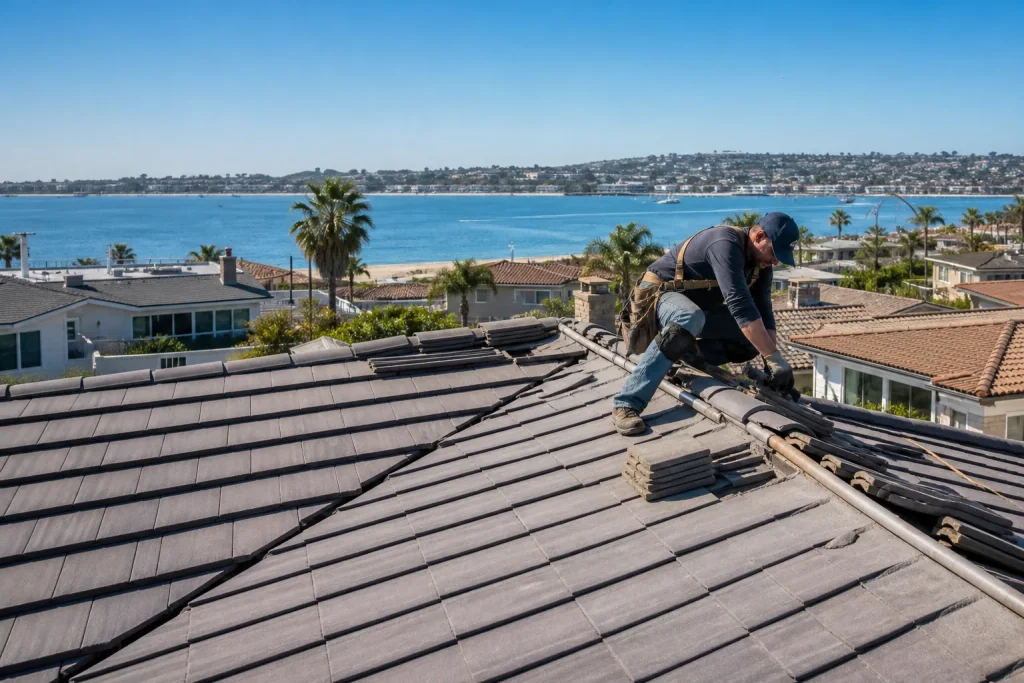
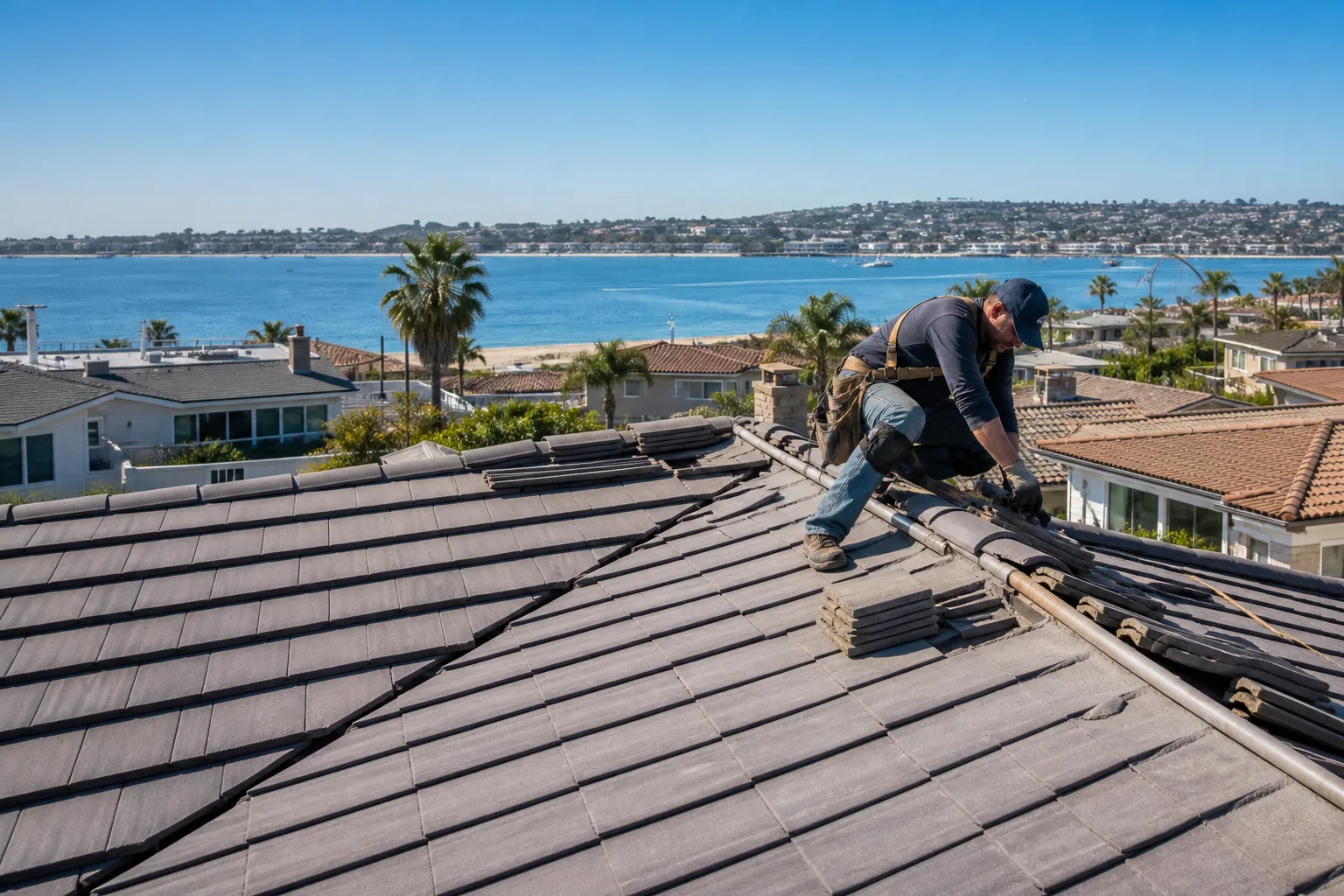
Roof Repair Cost Guide: What Newport Beach Homeowners Pay in 2026
Most Newport Beach roof repairs land between $650 and $2,400 in 2026, with tile work running noticeably higher than shingle patching. The spread comes down to material type, roof pitch, and whether the underlying underlayment needs replacement, not just the visible damage. If you’d rather skip the reading and get a line-item quote on your specific roof, call (833) 589-5180.
Here’s the thing most cost guides won’t tell you: the cheapest estimate in Newport Beach is frequently the one where someone cut corners on flashing, used a mismatched tile they had sitting in the yard, or skipped the permit entirely. You won’t find out until next winter’s rain or the buyer’s inspection report when you’re trying to sell. This guide exists so you can read an estimate and actually know what you’re looking at.
What Roof Repairs Actually Cost in Newport Beach
Roof repair pricing in Newport Beach runs about 15 to 25 percent above inland Orange County and LA County averages. We’re not talking about markup for the sake of markup. The reasons are concrete: coastal labor rates are higher because tradespeople commuting into Newport Beach spend more on fuel, parking, and time; material delivery to the peninsula and Balboa Island involves tighter streets and more coordination; and the sheer volume of tile roofs here means repairs take longer than the asphalt shingle work that dominates inland markets.
Here’s what we see across Newport Beach in 2026, broken down by repair type:
- Tile replacement (cracked or slipped tiles): $450 to $900 for a small cluster, depending on whether we’re matching existing Boral or lightweight concrete tile or sourcing reclaimed clay from a salvage yard. Tile matching on older Newport Beach homes adds real time because original profiles are discontinued.
- Flashing repair (chimney, skylight, or wall-to-roof junctions): $350 to $1,200. Chimney flashing on steep Newport Heights and Cliffhaven homes consistently runs at the top of that range because access is tight and the existing lead or galvanized flashing is usually decades past its service life.
- Valley repair: $700 to $1,800. Valleys channel more water than any other roof area, and on tile roofs a failing valley means pulling sections of tile to replace the metal beneath, not just caulking a seam.
- Ridge cap remortar and rebedding: $500 to $1,400. This is one of the most common repairs we quote in Newport Beach because salt air speeds up mortar erosion. Homes along 15th Street in Balboa Peninsula or the harbor side of Lido Isle tend to need this before inland homes do.
- Underlayment repair (small section): $600 to $1,500. If your leak has been ongoing, the underlayment beneath the tile is usually the actual failure point, and patching it correctly means lifting tile, replacing felt or synthetic underlayment, and relaying what came off.
Square footage matters less for repairs than for replacement, but complexity drives everything. A single-story roof with a 4:12 pitch that we can walk safely is a different job than a three-story Newport Coast tile roof with 7:12 slopes and ocean-facing weather exposure.
Why Newport Beach Pay More Than Inland Cities
Newport Beach is not a cheap place to build or fix anything, and roofing is no exception. We see estimates from homeowners who’ve compared our numbers against quotes from contractors in Santa Ana, Costa Mesa, or Irvine, and the gap can cause sticker shock. It’s worth understanding exactly where the coastal premium comes from.
First, labor. A qualified roofer who knows tile systems, can read a moisture meter, and doesn’t need to YouTube how ridge caps work commands a higher wage everywhere, and the wage floor in Newport Beach is higher because the cost of living around here filters out anyone who can’t make the commute math work. Most roofing crews serving Newport Beach are driving in from Riverside or north Orange County, which means fuel, vehicle wear, and an extra hour each way. That’s real money on every job.
Second, material logistics. Deliveries to Balboa Island, the peninsula, and parts of Corona del Mar involve narrow streets, parking restrictions, and sometimes a ferry crossing. A supplier charging $95 for forklift drop-off on a flat job site in Irvine may charge $160 for the same delivery where the truck has to time the street sweeper and offload by hand. Tile is heavy. Someone carries it up the ladder regardless of the address.
Third, Newport Beach’s housing stock skews toward tile roofs on complex geometries. Spanish and Mediterranean profiles with barrel tile, multiple dormers, and parapet walls are everywhere. Every one of those features adds cut time, waste factor, and a measuring tape’s worth of frustration. Asphalt shingles cut with a hook blade. Clay and concrete tile need wet saws, careful handling, and a different level of patience.
If you’re getting a repair quote for a Newport Beach roof and comparing it against an inland benchmark, expect the premium. If someone quotes you inland pricing, ask how they’re getting their crew and materials to the site for that number. The answer is usually either “we’re not paying for workers’ comp” or “we’ll let you know once we start.”
Permits: What Newport Beach Actually Requires
Newport Beach building code requires a permit for roof repairs that go beyond surface-level work, and the dividing line is worth understanding because it affects both your price and your resale liability. Replacing a handful of cracked tiles or resealing a minor flashing seam typically doesn’t trigger a permit. Replacing underlayment sections, repairing structural decking, or doing any work that involves removing and reinstalling a significant section of the roof system does.
A roofing permit in Newport Beach typically runs between $150 and $350 depending on the scope and valuation of the work. The city also requires inspections on permitted work, which means someone from the building department will visit the site to confirm the repair meets code before the permit gets closed. That’s a feature, not a hassle: a closed permit with a passed inspection is documentation you can hand to a buyer or an insurance adjuster.
The liability side is real. If you sell a home in Newport Beach with unpermitted roof work, the standard disclosure process asks whether all work was done with proper permits, and answering “no” doesn’t just feel uncomfortable, it typically translates into a price concession or a repair credit at escrow. Buyers in this market do their homework, and a savvy inspector will flag an underlayment repair that doesn’t match the city’s permit history.
Our starting point before any repair is to identify whether the job requires a permit, tell you plainly if it does, and include any permit fees in the upfront quote. No surprises on the invoice and no ambiguity at resale.
How to Compare Three Estimates Without Losing Your Mind
Most Newport Beach homeowners who call us with a roof problem are comparing at least two or three bids. Good. You should. The key is comparing line items that matter, not just the bottom number, because the bottom number hides what’s actually included.
A credible repair estimate should include these items, spelled out:
- Specific materials by name: GAF, CertainTeed, Owens Corning, or Boral products identified by product line, not just “roofing tile” or “flashing material.” Vague language means vague accountability later.
- Underlayment scope: Does the quote include replacing the underlayment beneath the repair area, or just patching over it? If it’s not listed, assume it’s not included.
- Flashings and fasteners: What type of flashing, what gauge, and how it will be fastened. A repair that reuses 30-year-old flashing is a temporary patch wearing a permanent price tag.
- Debris removal and disposal: Old tile and torn-off underlayment are heavy. If haul-away isn’t listed, someone’s leaving it in your yard or dropping it in a dumpster you didn’t agree to pay for.
- Permit and inspection fees: If the scope requires a permit and the quote doesn’t mention it, ask whether they plan to pull one. That answer tells you more than the price does.
- Workmanship warranty terms: Not a vague “we stand by our work” but an actual period, in writing, with the contractor’s name attached.
We pulled a job over in Lido Isle last winter where the homeowner had three quotes: $1,850, $2,600, and $4,100 for what looked like the same valley repair on a tile roof. The $1,850 quote reused existing flashing, skipped the permit, and didn’t include matching tile. The $4,100 quote replaced the entire valley with new copper, pulled permits, and included a full underlayment section replacement. The $2,600 quote did the same as the $4,100 but used standard galvanized rather than copper, which the roof didn’t need. Watching the homeowner’s face as we walked through the line items told the whole story: the cheapest option wasn’t cheap, it was deferred maintenance with a bow on it.
Repair or Replace: The $1,800 Question
If your roof is 20-plus years old and you’re looking at a repair quote that’s creeping toward $2,000, the honest conversation is whether that money buys you years or buys you months. The math isn’t complicated, but most roofing companies don’t want to have the conversation because replacing roofs is more profitable than fixing them. We don’t work that way because we’d rather tell you the truth now than hear it from you later.
Here’s the practical framing. A concrete tile roof in Newport Beach that was installed properly usually lasts 40 to 50 years, sometimes longer with maintenance. An asphalt shingle roof lasts 20 to 30 years depending on exposure, ventilation, and the quality of the original install. If you have a concrete tile roof that’s 25 years old and you’re repairing a flashing leak for $1,200, that’s usually money well spent because the roof system has decades of remaining life. If you have an asphalt shingle roof that’s 22 years old, prematurely granule-lossed from salt exposure, and the repair quote is $1,800 to patch multiple valleys and reseal the flashing, you’re putting a warranty on an asset that’s nearing the end anyway.
The other cost to factor in is the repeating repair cycle. We see it often enough to name it: a homeowner patches a leak for $600, then another for $900 eighteen months later, then another for $1,100, and after three years they’ve spent $2,600 on repairs that didn’t stop the underlying deterioration. At that point, the repair route has cost more than a targeted replacement would have, and they still need a new roof. Our approach at Sunridge Roof Repair is to inspect first and show you where your roof actually is in its lifespan, then let you make the call with real numbers. Roof Inspection in Lynwood is part of our full-cycle model, and Newport Beach homeowners get the same diagnosis-first process.
Related services in Newport Beach: if your repair scope suggests the roof is past its useful life, we’ll show you what a targeted Roof Replacement in Lynwood would look like and compare the five-year costs of both paths side by side. No pressure, just arithmetic.
What You Can Check Safely Before Calling Anyone
You don’t need to climb onto your Newport Beach roof to start narrowing down the scope. A pair of binoculars and a sunny afternoon will answer most of the basic questions, and knowing what you’re looking at makes you harder to overcharge.
From the ground or a safe ladder position, look for cracked or slipped tiles, especially near valleys and along the ridge line. Look at the flashing around chimneys, skylights, and any wall-to-roof intersections, where gaps or lifted metal indicate failed sealant or corroded material. Check your ceilings during the next rain for discoloration that spreads outward; a small stain is often the bottom point of a water path that started ten feet higher on the roof deck. And if you have easy access to your attic, look for dark streaks on the decking or daylight visible through small gaps.
If the damage involves areas within a few feet of roof edges, steep pitches, or anything requiring you to put full body weight on tile, call a professional. Tile roofs are deceptive; a surface that looks solid can crack under load or hide gaps that don’t support foot traffic. We’ve replaced enough cracked tiles this year to say confidently: the tile you break by walking on it costs more than the inspection would have.
Why Tile Repairs Cost More Than Shingle Repairs
Newport Beach has one of the highest concentrations of tile roofs in Southern California, and tile repair is a different trade than shingle repair. A roofer who’s fast on asphalt may be out of their depth on barrel tile, and the difference shows up in both quality and price.
The labor difference comes down to handling. Shingles arrive in bundles that weigh 70 to 80 pounds and cut with a hook blade. Tile arrives on pallets, often needs to be hand-carried to the eave, and has to be cut with a wet saw to match valleys, hips, and ridges. A single tile replacement on a Newport Beach roof may involve lifting three or four surrounding tiles, checking the underlayment beneath, setting new fasteners, and bedding the tile properly so it doesn’t shift in the first stiff wind off the Pacific. That’s twenty to thirty minutes of skilled labor for one tile, which is why a “simple tile crack” still costs a few hundred dollars when it’s done right.
Material matching adds another layer. Older Newport Beach homes, especially in the 1960s and 1970s tracts of Harbor View and Eastbluff, frequently have tile profiles that are no longer manufactured. Matching them means either finding reclaimed product or replacing with the closest current profile from Boral or another manufacturer and accepting a visual difference that may require adjusting a whole section. We carry access to GAF, CertainTeed, Owens Corning, and Boral product lines, so when a match exists in the current market, we can usually source it. When the profile is discontinued, we’ll tell you that directly and talk through your options, including whether replacing a larger section makes visual sense.
This is where brand-agnostic sourcing matters practically. A contractor tied to a single manufacturer will recommend the tile they sell, whether or not it’s the right match for your existing roof. Sunridge Roof Repair isn’t obligated to any single brand, so the recommendation is based on your roof’s existing system and your budget. That’s how we avoid the “close enough” mismatches that show up as discolored patches long after the invoice clears.
The Bottom Line
Roof repairs in Newport Beach in 2026 are running $650 to $2,400 for most jobs, with tile work, flashing, and underlayment issues at the higher end and simple surface repairs at the lower end. The coastal premium is real and comes from labor, logistics, and the tile-heavy housing stock, not from contractors padding numbers. The right way to evaluate any estimate is line by line: specific materials, permit scope, underlayment inclusion, and workmanship warranty. A repair under $2,000 on a tile roof with decades of remaining life is usually sensible. The same number on a 22-year-old shingle roof at the end of its service life may be a down payment on the replacement you’re doing anyway.
If you’re in Newport Beach and want a diagnosis before you spend, Roof Repair in Lynwood from Sunridge Roof Repair starts with an inspection, not a sales pitch. We’ll show you what’s actually wrong, whether it’s worth repairing, and what the line-item cost looks like before any work is scheduled. Call (833) 589-5180 for a free estimate.
Frequently Asked Questions
Most roof leak repairs in Newport Beach range from $450 to $1,800 depending on the leak’s source. Flashing failures around chimneys and skylights typically run $350 to $1,200, while valley leaks that require lifting tile and replacing underlayment can reach $1,800. Call (833) 589-5180 for an exact quote on your leak.
Newport Beach requires a permit for repairs that go beyond surface-level work, such as replacing underlayment sections or repairing structural decking. Minor tile replacement and small flashing reseals usually don’t require one. Permit fees typically run $150 to $350. We determine permit requirements during inspection and include any fees in the upfront quote.
It depends on the roof system. A concrete tile roof at 20 to 25 years old usually has decades of remaining life, making repair a sound investment. An asphalt shingle roof at 22-plus years with granule loss and recurring leaks may be nearing the end of its service life, and repeated repairs can cost more than replacement within a few years. A professional inspection gives you the numbers to decide.
Newport Beach roofing costs run 15 to 25 percent above inland Orange County due to higher coastal labor rates, tighter material delivery logistics on the peninsula and Balboa Island, and the prevalence of tile roofs that require more time and skill than shingle work. If an estimate comes in at inland pricing, confirm what the quote actually includes.
Written by the team at Sunridge Roof Repair, serving Newport Beach since 2011.
Need Roofing Help?
Call Sunridge Roof Repair — licensed & insured, here with fast after-hours help in Lynwood.
(833) 589-5180