Boral Roof Repair in Newport Beach: A Homeowner’s Guide
Boral roof repair in Newport Beach typically costs between $450 and $1,800 depending on whether you’re replacing a few cracked tiles or rebuilding a failed mortar ridge line. Most repairs take one day, and the real variable isn’t labor, it’s whether your contractor can source the exact Boral profile your roof was originally built with. If you’d rather not sort through tile samples on your own, call (833) 589-5180 and we’ll match the profile for you.
Boral concrete tile has been on more Newport Beach roofs than most homeowners realize. Walk down any street in Corona del Mar, Newport Heights, or Dover Shores and you’ll see it, usually in the classic two-piece mission profile or a flat shake style. The biggest repair mistake we see isn’t a sloppy installation. It’s a contractor who grabs a “close enough” tile from a supply yard because they don’t carry the right profile, then tells the homeowner it’ll blend in. It won’t. Not in six months, not in six years. If you’re in Newport Beach and need help, Sunridge Roof Repair home offers free estimates and starts every job with a profile match, not a guess.
How Boral’s Concrete Tile System Actually Works
Boral roof tile is a concrete product, not clay, which matters more than people think in a coastal climate like Newport Beach. Concrete tile is denser and heavier than clay, usually weighing 900 to 1,100 pounds per square (100 square feet). That weight is part of the system. The roof deck, underlayment, and battens are all sized around it. When someone swaps in a lighter substitute tile, the interlocking geometry changes, and so does the way water moves across the roof.
Each Boral profile is designed with a specific interlocking shape. The two-piece mission tile, the most common profile on Newport Beach homes, has a cap and pan design where the curved cap channel sits over two flat pans. The overlap isn’t cosmetic. It’s what keeps wind-driven rain from finding a seam during the winter storms that hit the Balboa Peninsula. A tile that looks similar from the ground can have a different channel depth, a different kick angle, or a different length. Any one of those differences creates a weak point.
Water doesn’t care about color. It follows the geometry. When we inspect Boral roofs in Newport Beach, we look at the profile run-out first, because that’s where mismatched tiles show up: inconsistent overhangs at the eave line, slight gaps where the nose doesn’t sit flush, or cap tiles that ride a quarter inch higher than the originals. These small tells mean water is getting places it wasn’t meant to go.
The Three Most Common Boral Failure Points on Newport Beach Roofs
Coastal air does specific things to concrete tile. The salt, the fog, the morning marine layer, the occasional Santa Ana wind blast: each leaves its mark. In our experience across Newport Beach, from Lido Isle up to the bluffs above the Back Bay, three problems account for most Boral repair calls.
Efflorescence. This is the white, chalky bloom that appears on concrete tile. It happens when moisture inside the tile draws mineral salts to the surface. Near the ocean, efflorescence shows up faster because the tile absorbs salt-laden air, not just rainwater. Efflorescence on its own usually doesn’t mean the tile has failed structurally, but it does mean moisture is moving through the tile more than it should, which is a signal to check the underlayment beneath. If you’re seeing widespread efflorescence on a Boral roof in Newport Beach, the roof needs an inspection, not just a rinse.
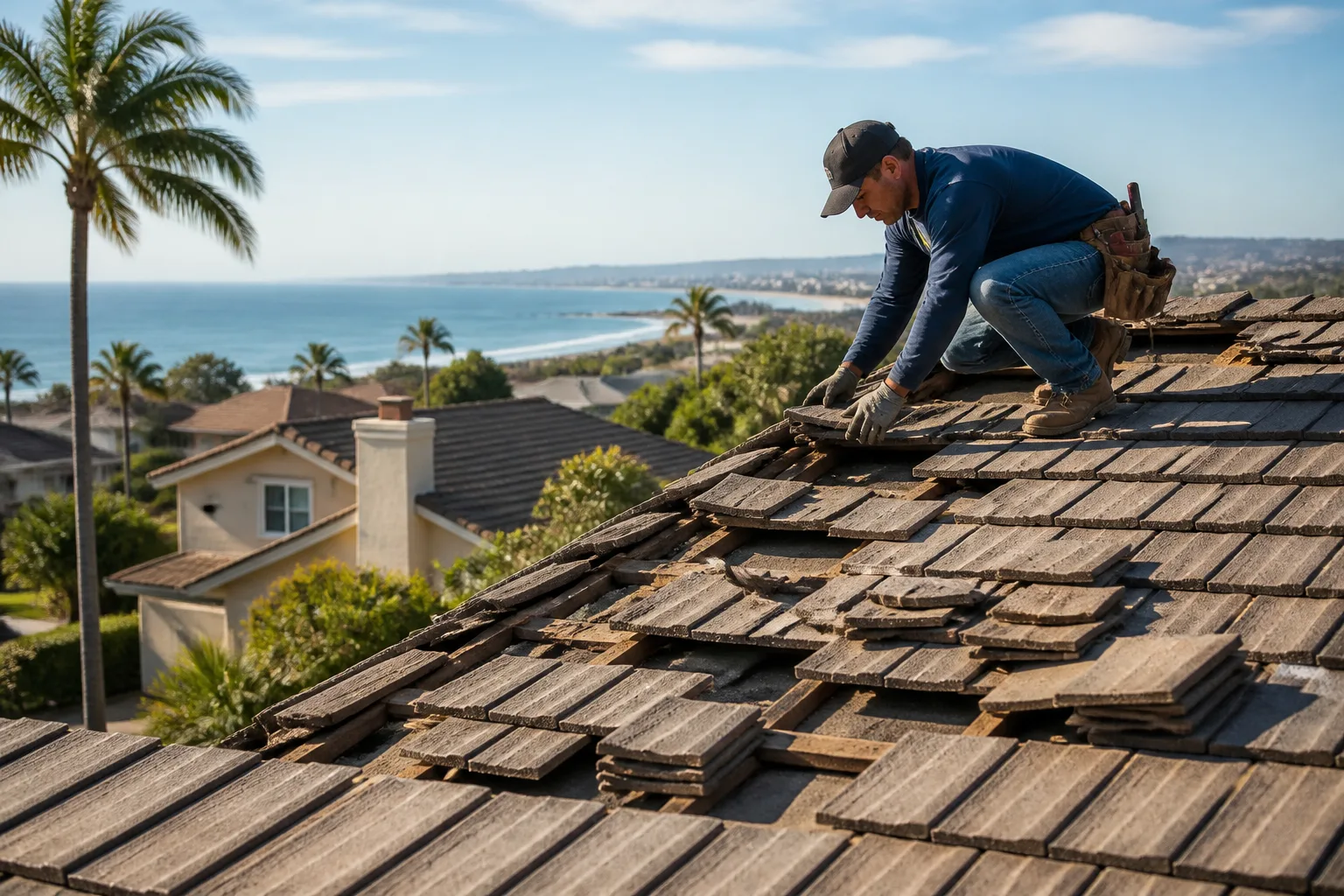
Broken field tiles from foot traffic. Concrete tile is strong, but it doesn’t forgive a wrong step. HVAC technicians, solar installers, chimney sweeps, satellite repair crews: we’ve all seen the cracked tile pattern that follows their path across a roof. In neighborhoods like Harbor View and Bonita Canyon, where homes sit on steep pitches, foot-traffic damage is even more common. The fix is usually straightforward, a few tile replacements, but the broken tile has to be removed without disturbing the interlock around it. That takes a roofing crew, not a handyman with a caulk gun.
Mortar ridge failure. The ridge is where the roof takes its biggest hits. Sun exposure, wind, and the slow expansion of concrete tile against mortar all work on the ridge cap over time. When mortar cracks and falls away, the cap tiles start to shift. Left alone, water enters at the highest point of the roof and travels down the trusses before it shows up as a stain on a ceiling. A faded stain on a bedroom ceiling in Eastbluff is often a ridge problem two valleys away. Newport Beach roofers get a lot of these calls after the first real rain of the season.
If any of this sounds familiar, check our related service page: Roof Repair in Lynwood shows how we approach repair diagnostics, even for homes outside Newport Beach.
What to Ask a Contractor Before Any Boral Repair
The conversation you have before the repair determines how the repair goes. Here’s what we’d tell any Newport Beach homeowner to ask, straight from the questions we get every week.
- Do you have current Boral product access? Boral’s tile manufacturing and distribution changed hands in recent years. Not every supply yard in Orange County stocks current Boral profiles. A contractor who says “Boral or equivalent” isn’t giving you an answer, they’re telling you they plan to substitute. At Sunridge, we work with Boral among names like Owens Corning and IKO to source the right profile rather than whatever’s on the shelf.
- Can you show me a profile match before work starts? The contractor should bring a sample tile or a photo comparison to the job. They should be able to name the profile, the color, and the run length. If they wave that off, that’s a red flag. On the roof, a one-inch difference in tile length changes the exposure and breaks the visual line.
- Do you inspect the underlayment as part of the repair? Tile is the armor. The underlayment is the waterproofing. On a Boral roof in Newport Beach, the underlayment is almost always the older, weaker layer. If you’re replacing more than a few tiles in one area, the underlayment beneath should come up for inspection. We pulled one out of a garage over near the Newport Shores neighborhood last month that was so brittle it crumbled in our hands, and it had been “protecting” the roof for 25 years.
- What’s the warranty on repair work versus materials? Be clear on who covers what. A Boral tile generally carries its own manufacturer warranty, but repair labor typically doesn’t fall under it. Get both in writing, or at least in an email.
Why the Underlayment Under the Tile Matters More Than the Tile
A Boral tile’s design life can hit 50 years or more. The felt or synthetic underlayment under it: 20 to 30 years, often less near the coast, where trapped moisture and heat cycles wear synthetics faster. We say this in nearly every inspection: tile is not the roof. The underlayment is the roof. Tile protects the underlayment from sun and physical damage, but if the underlayment has failed, the tile becomes decorative.
In Newport Beach, this distinction matters more because of the microclimate. A home up on a ridgeline in Belcourt gets more direct sun, which bakes the underlayment through the tile’s thermal mass. A home a block off the sand in Balboa gets more salt fog, which works its way into any seam that’s begun to lift. When you replace a broken Boral tile without looking beneath, you’re often repairing the symptom while the actual waterproofing layer continues to fail.
A proper Boral repair starts with a simple question: is the underlayment in this specific area still doing its job? If it is, replace the tile and move on. If it isn’t, a patch repair might buy you a few short years, and you should know that going in. That honest assessment is the difference between a repair that lasts and one that sends you back up the ladder in two winters. For more on how we inspect before recommending any work, see Roof Inspection in Lynwood.
Boral Warranty: What’s Covered, What’s Not, and What to Keep
Boral tile is a solid product and the manufacturer backs it, but the warranty shell has limits that surprise homeowners. The manufacturer warranty generally covers manufacturing defects that show up over time: cracking from internal stress, color fade beyond stated limits, spalling of the tile surface. It does not cover installation errors, foot-traffic damage, storm damage, or the failure of materials underneath the tile. If a repair fails because the underlayment gave out, the Boral warranty won’t be writing a check.
For repairs, the workmanship warranty comes from the contractor, not Boral. That’s why the contractor’s licensing, reputation, and willingness to stand behind their labor matters so much. When you hire someone to repair a Boral roof in Newport Beach, ask what workmanship period they offer on their repair work. A contractor who can’t answer that question clearly is one more reason to keep looking.
Documentation matters. Keep the tile profile name and color code, the date of installation, the contractor’s name and license, and photos of the repair before and after. If you’re buying a home with a Boral roof, ask the seller for the original installation paperwork. If it doesn’t exist, an inspection can still identify the profile, but you’ll lose some of the warranty trail. If the roof is nearing replacement age rather than repair age, our Roof Replacement in Lynwood page walks through material options, including Boral and alternatives like Atlas and Tamko.
When to Call a Pro
If you can see broken tiles, missing ridge mortar, or water staining inside the house, call a roofer. Don’t climb up with a tube of sealant and hope. Concrete tile is heavy, the interlock is precise, and walking on it without knowing the right step pattern causes more cracks than it fixes. We’ve seen weekend repairs turn a $500 tile replacement into a $3,000 repair because someone stepped through a weakened field tile near the ridge.
Boral repair isn’t a specialty you want to gamble on. The contractor needs product access, pattern knowledge, and the patience to do the job without disturbing surrounding tile. If you’re in Newport Beach and want a straight answer about what’s actually wrong with your roof, speak with a dedicated roofing specialist. Sunridge Roof Repair inspects before we recommend, and we work with the brand that fits your roof and your budget. Estimates are free, and there’s no charge to have us tell you the repair can wait.
The Bottom Line
Boral tile roofs are built to last decades in Newport Beach, but only if repairs match the original profile and address the layer beneath the tile. Mismatched tiles compromise water flow and resale appearance. Broken field tiles and failed ridge mortar are the most common coastal failure points, and the underlayment under any repair zone deserves a look before the tiles go back on. Ask your contractor about Boral product access, profile matching, and warranty scope before any work starts.
If you’re in Newport Beach and need help, Sunridge Roof Repair offers free estimates. Call (833) 589-5180 and we’ll match your profile, check your underlayment, and give you repair options that don’t depend on what’s convenient in the yard.
Frequently Asked Questions
Most Boral repairs in Newport Beach fall between $450 for replacing a handful of broken tiles and $1,800 for a full mortgage ridge rebuild with new cap tiles. The price depends on how many tiles you’re replacing, whether the underlayment beneath needs repair, and how accessible the roof area is. Call (833) 589-5180 for an exact quote on your specific repair – estimates are free.
Yes. A roof with visibly mismatched tiles reads as a deferred maintenance problem to buyers and inspectors, even if the repair is structurally sound. Real estate photographers in Newport Beach shoot roofs from drones now, and a patch of off-profile tile shows up in listing photos. Beyond resale, mismatched profiles create real water-channeling problems at the seams.
Boral tile can usually be repaired, especially when the issue is isolated broken tiles or ridge mortar failure. Full replacement is only necessary when the tile is largely failed, the install was poor to begin with, or the underlayment has degraded across a large area. A roof inspection tells you which situation you’re in before you spend anything.
We have access to current Boral product lines and can source the correct profile for Newport Beach homes. We also work with Owens Corning, IKO, Atlas, and Tamko, so if Boral isn’t the right fit for the repair or your budget, we’ll show you options that match your roof and your needs. Repair when repair is right, replace when it’s not.
Written by the team at Sunridge Roof Repair, serving Newport Beach since 2011.
Need Roofing Help?
Call Sunridge Roof Repair — licensed & insured, here with fast after-hours help in Lynwood.
(833) 589-5180